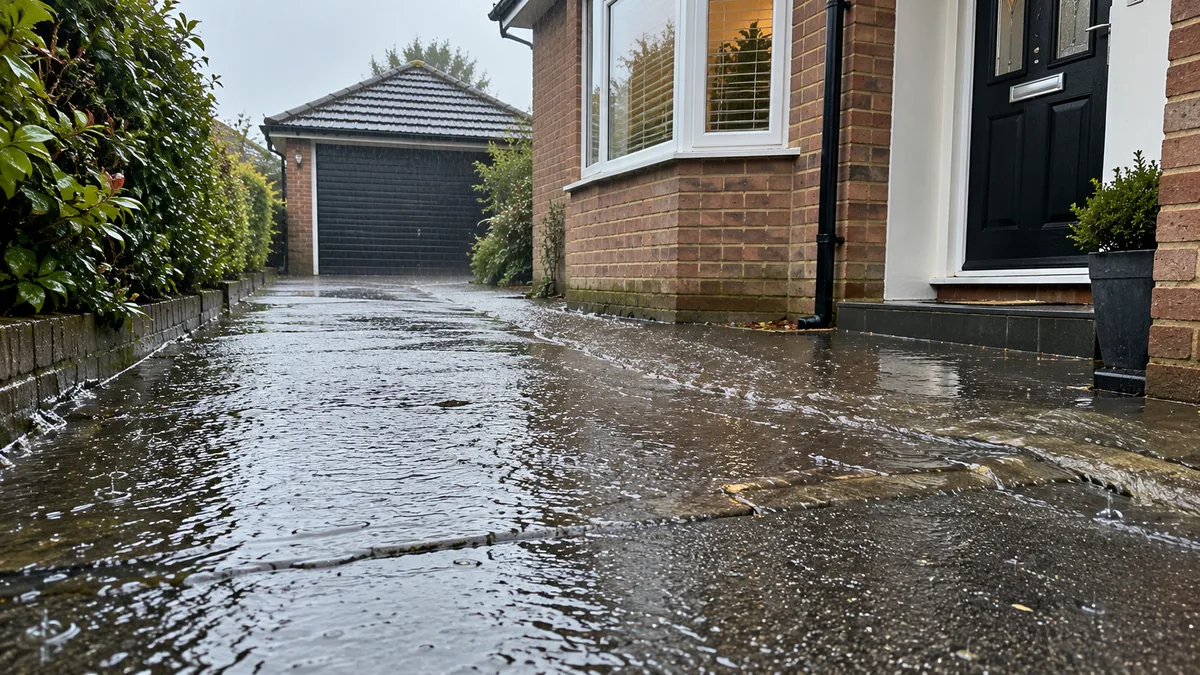
Follow the route
Start at the highest point of the driveway and see where water naturally runs. A down-slope towards a low doorway, garage or basement stairwell is an obvious concern, particularly if there is no clear interception point.
The drainage channel
A channel drain can collect water before it reaches the building, but only if it has a suitable, functioning outlet and enough capacity. Merely fitting a grille across the drive does not guarantee protection.
Levels and thresholds
A tiny change in finished paving level can create a direct route into a house. Replacing a driveway without maintaining appropriate thresholds, damp-proofing details and falls can make things worse.
Planning and runoff
Front garden paving in England can engage planning rules, depending on permeability, drainage and the area involved. Seek the current local requirements rather than assuming every hard surface is permitted.
Look beyond the surface
Repeated flooding may indicate blocked gullies, undersized pipes or runoff arriving from the highway. Find the cause before paying for new surfacing.
What a useful quotation includes
Ask for proposed gradients, drainage location, disposal point and how the contractor will avoid directing runoff onto adjoining land.
See where the water gathers first
Water moving down a driveway towards the house is usually a levels and collection problem. Watch a rainfall event from safety and note whether flow arrives from the road, runs off the driveway itself or escapes from a blocked channel or gully. A single photograph of standing water after the storm cannot always show the route it took.
If the driveway was resurfaced recently, compare the height of paving beside the door, garage and airbricks with the original arrangement. Even a relatively small change of fall can redirect runoff.
The door threshold is only the final weak point
Water may appear to leak through the garage or front door, but improving the seal will not necessarily help if the driveway continues to funnel runoff against it. Examine the paving gradient, low spots, adjacent walls and the position of any drain. Existing flood barriers also have limits because water may enter through nearby openings.
If the internal floor sits close to external paving, a competent builder may need to assess the threshold detail as part of the drainage design.
Channels must lead somewhere suitable
A grated channel can collect water across a slope, but it needs a reliable discharge route and adequate capacity. An outlet blocked with silt or connected to a flooded receiving drain may cause water to overflow at the very point you are trying to protect.
Ask the contractor where the channel empties and whether that connection is permitted. A soakaway is not appropriate in every soil or location and must be considered in relation to buildings and other services.
Think carefully before altering the driveway
Raising part of the drive could push water into a neighbour’s property or against a different wall. Cutting a trench close to foundations can also create risks. Where parking surfaces are replaced, surface-water drainage requirements may apply, especially to impermeable front gardens.
Check planning and drainage requirements with the local authority as necessary, and consider whether permeable construction would work for the site.
Ask for a measured explanation
A useful quotation should describe existing falls, the proposed level changes, the collection point, discharge route and reinstatement. Photographs or a simple plan make it easier to compare proposals. Avoid paying for a larger grate without evidence that the grate, rather than the outlet or ground levels, is the limiting factor.
After work is completed, keep the drain accessible for cleaning and inspect it during rain. If water still reaches the threshold, ask for the cause to be reviewed before authorising more work.
What to do while arranging a permanent repair
Keep the channel grates and visible outlets clear where they can be reached safely, but do not lift heavy covers or enter floodwater. Move vulnerable belongings away from the lowest part of the garage or hallway, and check official flood warnings if heavy rain is expected. Temporary barriers can help with shallow runoff but are not a substitute for correcting unsuitable levels or faulty drainage. If water has reached electrical equipment, leave it isolated until a competent electrician advises that it is safe.
Reliable further information
For current warnings, official flood-risk maps and safety advice, use the relevant government service. This website cannot assess live conditions at your home.
Government flood guidance · National Flood Forum · Citizens Advice