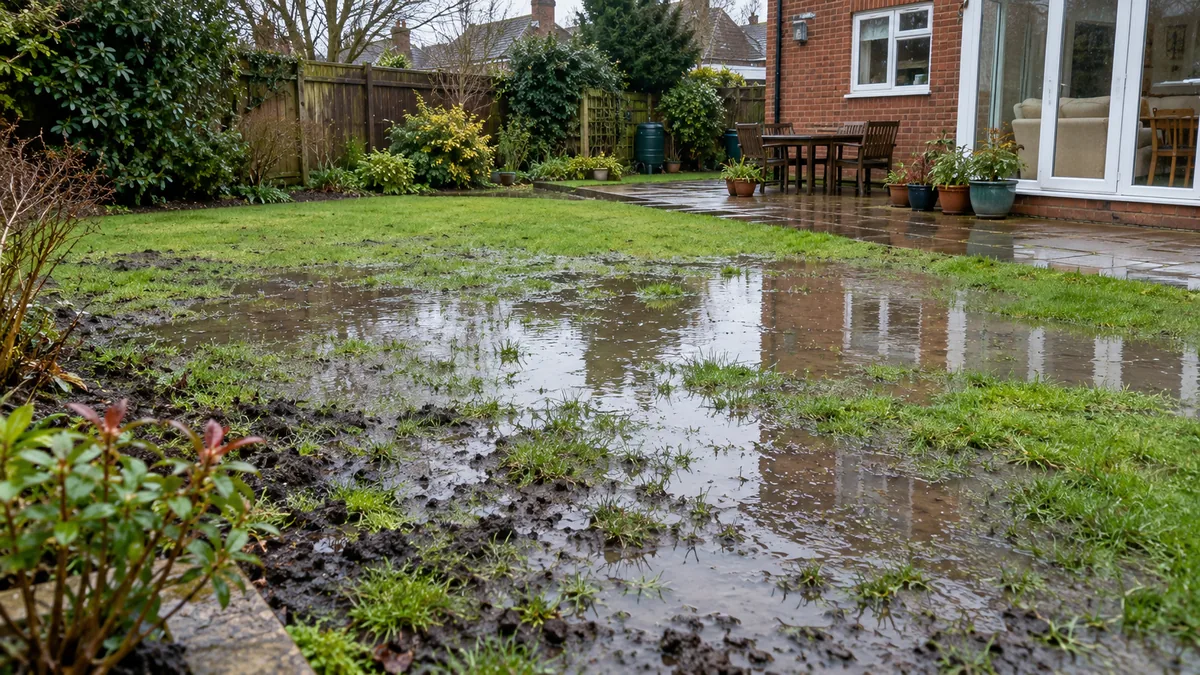
First establish the pattern
A garden that remains wet for days after rainfall presents a different problem from a sudden stream of water crossing a patio. Look for changes after heavy rain, newly laid paving and areas where the ground has been raised.
Clay and compacted soil
Clay soils can drain slowly, especially when waterlogged. Compaction from machinery and repeated foot traffic can make infiltration worse. Digging one hole and finding water does not, by itself, prove the full drainage design.
Check the outlets
A patio gully may be full of leaves or connected to a defective pipe. Check visible gratings without entering floodwater or lifting heavy covers. An inspection may be needed to see where the drain runs and whether it is working.
Do not rely on a soakaway blindly
Soakaways need appropriate ground conditions, spacing from buildings and a suitable design. They may perform poorly in impermeable soil or where groundwater is high. Some works also have planning or drainage requirements.
A sensible solution
Possible measures include regrading, permeable surfaces, rain gardens, drainage channels or a properly designed system leading to a lawful outlet. The right choice depends on why the garden floods.
Getting a quote
Ask contractors to explain their diagnosis, the intended water destination and what maintenance the proposed system will need. A trench full of gravel is not automatically a complete drainage solution.
Map the water before digging
A puddle in a lawn may result from compacted soil, heavy clay, a shallow low point, a blocked outlet or runoff from adjoining hard surfaces. Note how quickly standing water appears, where it is deepest and how long it remains after the rain stops. A garden that remains wet for days does not necessarily need a deeper pit: ground infiltration may already be poor.
Drainage needs a suitable destination
A land drain, soakaway or regrading scheme needs to be designed around ground conditions, nearby foundations and lawful discharge routes. An outlet into an unsuitable soakaway can simply move the problem underground. Avoid directing water onto adjoining land or towards the house. Ask the contractor what investigation supports the proposed solution and what maintenance will be needed. In some gardens, reducing impermeable surfaces and managing runoff at source can be more helpful than adding another pipe.
Reliable further information
For current warnings, official flood-risk maps and safety advice, use the relevant government service. This website cannot assess live conditions at your home.
Government flood guidance · National Flood Forum · Citizens Advice